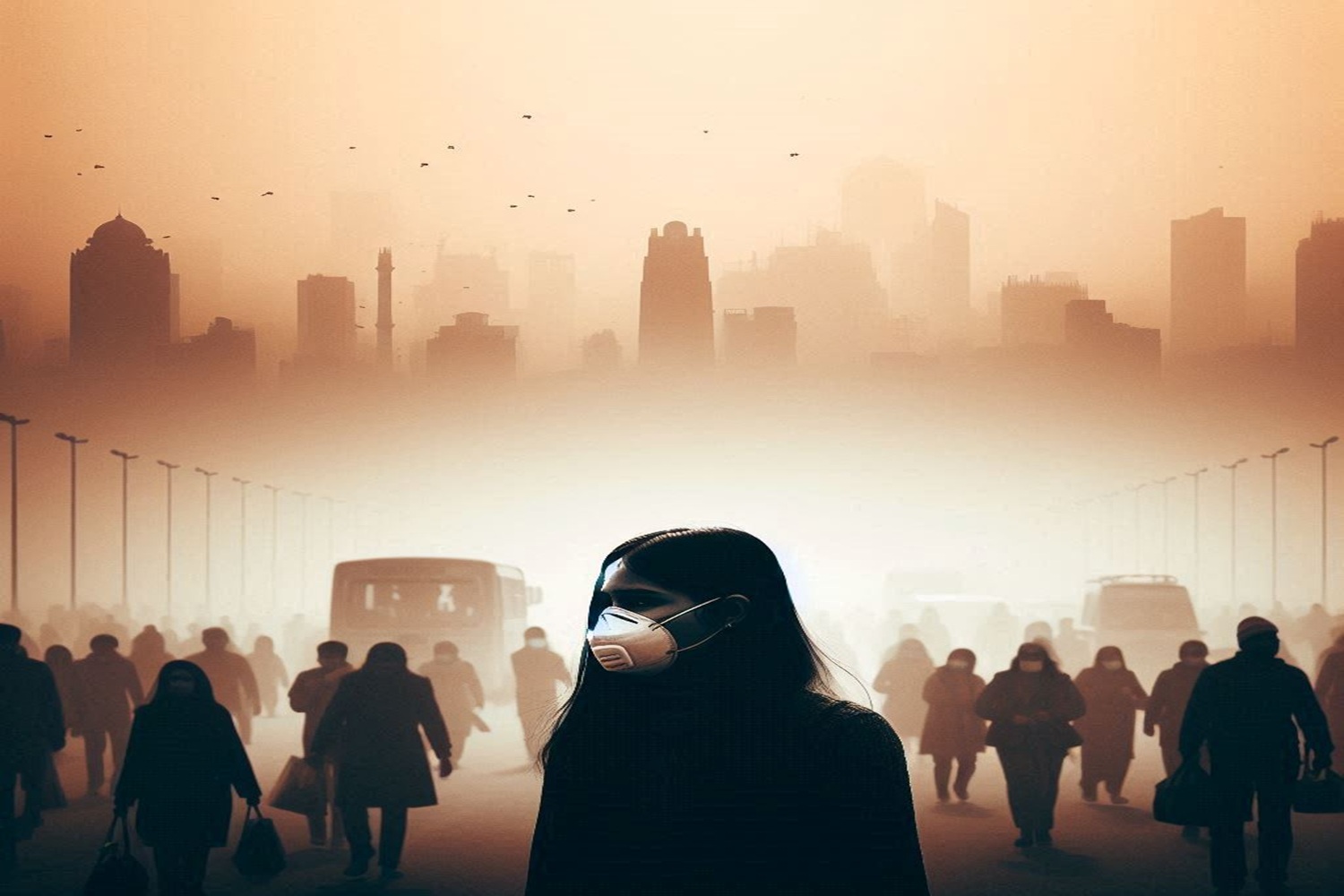
Is it new to discuss Delhi’s toxic air? Absolutely not. Over the last few years Delhi has been appearing as the gas chamber where the residents struggle to breathe fresh air. And this year once again Delhi’s toxic air has placed the nation’s capital under a suffocating spotlight.
Only a few decades ago, the city snatched the spotlight of discussion as a hub of vibrant life and culture. But the days are gone now. The city now struggles to breathe under the layers of intolerable smog and dust.
The constant increase of pollution has turned the capital into a living gas chamber where clean air has become a privilege and breathing a challenge.
Delhi’s Toxic Air: The Everyday Struggle for Breath
Every winter, Delhi transforms into a fog of pollution. Moreover, this fog remains so thick that the sole savior of the solar system, the Sun itself, seems imprisoned.
On a regular basis the Air Quality Index, or AQI, climbs into the “severe” zone. As a result, the unbearable air quality is now forcing schools to close and residents to stay indoors as much as they can.
In addition, the worst part is the danger doesn’t disappear when the seasons change. Without any doubt, Delhi’s toxic air lingers all year long. At the same time, this toxic air affects as well as damages lungs silently and ensures shortening lives.
Hospitals across the capital city have already reported alarming rises in respiratory illnesses among both children and adults.
The biggest concerning fact is doctors warn that prolonged exposure to this poisonous air can lead to several major health problems, including asthma, lung cancer, and heart complications.
Several platforms have revealed that many Delhiites feel scared while stepping outside. They think that walking outside without a mask is like inviting death. In a word, a panic button is very much active in the residents of the city. Some acute critics even opine that, for non-smokers, breathing in the city means lighting a cigarette every minute.
Why Delhi’s Air Has Become Unlivable
One important fact isDelhi’s pollution problem is not the result of one single cause. In fact, it is a perfect storm. Vehicle emissions, construction dust, industrial smoke, and stubble burning in nearby states combine to give birth to a deadly cocktail.
Moreover, at the heart of the crisis lie poor urban planning and weak environmental enforcement.
The bitter reality is that over the years Delhi’s rapid expansion has come at the cost of its green lungs. Yes, green lungs that include trees, wetlands, and open spaces that once filtered the air and now have been replaced by concrete.
The advancement of public transport is not adequate to address the growing population. And this reality is pushing more people toward private vehicles.
The situation even becomes severe with the seasonal burning of crop residue in Punjab and Haryana. It aggravates the entire situation and plays one of the crucial roles in making Delhi a toxic bowl each winter.
Government Measures: Too Late and Too Temporary
So far, Delhi’s leaders have launched several short-term measures like odd-even traffic schemes, bans on firecrackers, and anti-smog guns. However, none of them appeared with successful outcomes. Some measures even could not get proper implementation due to political chaos. And due to this, none of them provided lasting relief.
According to the Ministry of Environment, Forest and Climate Change, the National Clean Air Programme, or NCAP, launched in 2019, promised to cut pollution by 40% by 2026. However, without concrete rules and strict execution, the aim remains unachievable.
Furthermore, lack of coordination among states and public accountability let the progress remain painfully slow. Some even say the progress is invisible.
It is a pain to say that when the residents as well as the authority will understand that India’s capital deserves better than half-hearted fixes and blame games.
Can Delhi Be Saved from Its Toxic Air?
Reversing this damage is not a one-day’s work. Everyone, including the inhabitants and local authority, must understand that reversing the situation will need more than government orders.
Citizens and industries must share responsibility. There should be some immediate and rapid initiatives like encouraging the use of electric vehicles, supporting cleaner fuels, managing waste responsibly, and planting more trees.
Schools need to come forward and start educating children on sustainability. Instead of bogus political discussion, media can keep pollution at the forefront of national discussion.
If immediate, collective action isn’t taken, Delhi’s toxic air will no longer be a seasonal crisis. Rather, it will define the city’s identity.
The tragedy is clear. The capital of India was once full of energy and ambition. But now it is a city that literally can’t breathe.