The concept of equality in the human mind unlocks the dream of a society without kings. Yes, a human world where no one rules over another. A society where everyone enjoys equal wealth and power. However, the crucial question is whether such a system can truly breathe in real life. Several questions regarding this long-desired fascinating dream unlock a bigger concern: whether such a system may collapse into chaos even if it comes to reality.
Many historical documents have revealed how philosophers, thinkers, and revolutionaries imagined a society without kings or rulers. Yes, they dreamt of a world without elites or a centralised authority. Their thought shaped an idea that even today assures a society that can promise justice, freedom, and fairness. But reality utters a different truth.
The Dream of a Society Without Kings
Dreaming a society without official rulers often represents the core concept of equality and freedom. This system confirms no person holds absolute power. Moreover, it assures everyone must enjoy equal opportunity and wealth. Also, it determines decisions must emerge after collective understanding and can’t be imposed.
There is no denying that this concept is utterly appealing, as it challenges a core issue of society, i.e., inequality. And every decade of human civilisation experienced the existence of inequality.
The concentration of power and wealth in the hands of a few people is a bitter reality that existed during the time of ancient empires and is deeply present even in the so-called modern civilised nations. And this unfair sharing of power and wealth emerged with a term, “inequality”, and at the same time gave birth to a natural human demand called “equality”.
Now, it pinpoints one simple truth: that the said dream is not a mere political version; rather, it is deeply associated with human lives. People have now learnt to seek dignity, fairness, and desired control over their own lives.
Have We Ever Seen a Society Without Kings in Reality?
A perfect society without kings is undeniably a distant dream. History reveals that it never fully existed in the human societal world. Only there have been some systems that came close to that desired society obtaining some certain ways.
Small tribal communities, for example, often operated without formal rulers. Their decisions were made collectively; even available resources were shared equally with collective decisions. Interestingly, these societies survived for long periods. Now, this suggests one clear thing: that a leaderless or semi-equal system can work fruitfully, but this success is possible mainly on a small scale.
On the contrary, several instances have already shown that when populations grew, it became utterly difficult to maintain such equality. The reason is larger societies always require robust organisation, good coordination, and a strong system for maintaining fair control. The lack of these qualities unlocks chaos and forces a quick, disorderly situation to emerge.
The Role of Power in Human Nature
Human nature is the final weapon to design a society. Similarly, human nature itself is one of the biggest challenges in building a society without kings.
People are not identical, especially in ability, ambition, or influence. Some people naturally take initiative, and they emerge as the holders of leading positions. In addition, other people choose to follow them.
Now, the crucial fact is that over time these differences create one kind of informal hierarchy. Many cases have shown that such informal hierarchies ensure the emergence of unofficial leaders.
Interestingly, these leaders often do not wear crowns or hold any official title. But, despite this, they still influence decisions and control the outcomes. And this triggers an important question: Can power truly disappear forever?
The Economic Challenges of a Society Without Kings
A society without kings faces serious economic issues.
The first issue is motivation may decline if it appears that everyone receives equal rewards regardless of effort, skill, or innovation. Yes, people could start thinking, ‘Why do they work harder if the result and rewards remain the same?’
Many real-world experiments have proved the reality of such concern where strict equality was enforced. These experiments have shown productivity often slowed, and even the urge for innovation decreased.
Now, the vital question is can inequality in the society bring a fruitful productive outcome? The answer is no. The absolute opposite extreme, i.e., severe inequality, also creates severe problems like poverty, unrest, and instability.
The actual real challenge is balance. Yes, how can you maintain fairness when you are encouraging growth and progress at the same time?
Do Leaderless Systems Lead to Freedom or Chaos?
So, the above point unveils a serious concern: whether leaderless systems ultimately lead to freedom or chaos.
Apparently, the term ‘a society without kings’ may sound like the ultimate form of freedom, although it raises some practical concerns. The first practical concern is who can make essential decisions during the time of emergencies when there is no one to lead.
The second one is how disputes can be solved when no pioneering figure is ready to guide. And the last one is who can ensure required rules are followed in a society without rulers.
The reality is a completely decentralised system makes the decision-making process slow as well as complicated. Furthermore, the absence of a clear authority let disagreements lead to utter confusion or conflict. In addition, sometimes, the absence of leadership creates a vacuum.
And the irony is this vacuum is often seen filled by hidden or unofficial power figures. That means the repetition of recreating inequality in a different form.
Modern Examples and Experiments
Now, some people may ask whether a society without kings is actually possible or whether talking about it means a mere baseless discussion or wastage of time. The answer is elements of such a society can be seen in today’s world but not in a pure form that the human concept often draws. Worker cooperatives are the best examples where ownership is shared.
There are some communities that emphasise collective decision-making. Moreover, the presence of decentralised digital systems displays how these systems operate without any central authority.
Now, these models show that key aspects of a leaderless system can surely work but under certain conditions. However, one major warning is that scaling this limitation to an entire nation or global level appears to be extremely challenging.
The Psychological Factor
Human psychology is another major barrier to shaping a society without kings. It is necessary to understand that people don’t just want equality. They also seek recognition, status, and achievement. And, these desires naturally create some prime differences in influence and wealth.
The important thing is rigorous initiatives may help achieve financial equality to a certain height. But the search for the best skills and individual initiative for building reputation or popularity create social hierarchies. This suggests true equality is not just about systems. In truth, it is more about human behaviour.
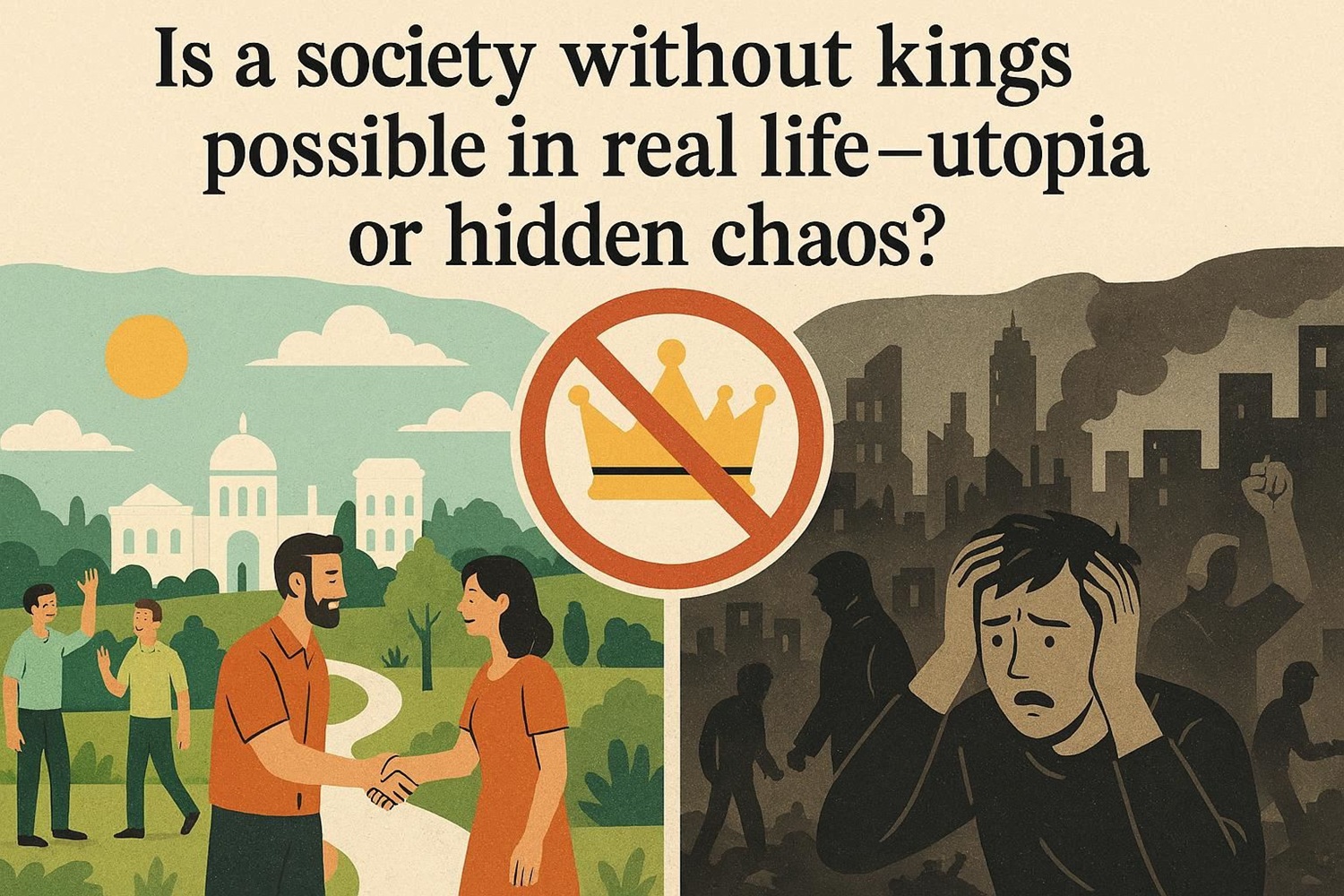
Utopia or Hidden Chaos?
So, once again, the same question arises: whether a society without kings can be the realistic future or if it is nothing more than an impossible dream.
The answer is not simple.
It is already discussed that human nature and economic realities are the root causes that make it difficult for a completely equal, leaderless society to sustain on a large scale.
However, valuable aspects like fairness, shared responsibility, and reduced inequality are surely achievable, and these ideas ultimately establish the concept of a society without any rulers.
Actually, instead of aiming for perfection, societies may benefit from aiming towards making a balance. For example, a society can be the witness of equality if it can reduce extreme inequality. Ensuring equal opportunities and promoting transparent and fair governance are two key pillars behind achieving the said balance.
Final Words
It is true that for many years the idea of a society without kings has been encouraging debate and imagination. It is undeniable that the concept of such society may never fully exist in its purest form, but the idea has already influenced the probability of evolution of modern societies.
There is no denying that the pursuit of equality has made meaningful progress in democratic systems and unlocks the path for more human rights movements. It is essential to understand that the aim is not to eliminate all differences. It is an effort to ensure that those differences do not lead to injustice or oppression.
In conclusion, the actual vision of a society without kings is not just about removing rulers. It is more about creating a world where everyone can access fairness and dignity.