Tiananmen Square remains one of the most significant and controversial events of the modern era, and 37 years after the crackdown of June 4, 1989, its lessons continue to resonate far beyond China’s borders.
History is often remembered through victories, celebrations, and achievements. Yet some of its most important lessons come from tragedies that governments and societies struggle to confront. The events that unfolded in Beijing’s Tiananmen Square in the spring of 1989 belong firmly in that category. Even after nearly four decades, the memory of Tiananmen Square continues to provoke reflection on the relationship between citizens and the state, the power of public dissent, and the enduring importance of historical memory.
The protests that culminated in the Tiananmen Square crackdown began as a largely peaceful movement. Students, intellectuals, and ordinary citizens gathered to demand political reform, greater transparency, and stronger measures against corruption. Their calls reflected aspirations that have appeared throughout history in many different countries: the desire for a more accountable government and a greater voice in public affairs.
What made Tiananmen Square remarkable was not only the scale of the demonstrations but also the hope they represented. For weeks, the square became a symbol of civic engagement. Young people believed they could help shape the future of their nation. Their presence reflected optimism that dialogue and reform were possible.
The violent end to those demonstrations transformed Tiananmen Square from a place of political activism into a symbol of sacrifice and unresolved questions. The exact number of casualties remains disputed to this day, adding another layer of uncertainty to an event already surrounded by political sensitivities. Yet regardless of the precise figures, there is little doubt that the crackdown marked a profound turning point in modern Chinese history.
One of the most enduring aspects of Tiananmen Square is the contrast between memory and silence. Around the world, the events of June 4 are studied, discussed, and commemorated. Within mainland China, however, public discussion of the crackdown remains heavily restricted. This raises an important question: Can a society fully understand its present without openly examining its past?
History cannot be changed by limiting discussion about it. Facts may become less visible, but they do not disappear. The continued global interest in Tiananmen Square demonstrates that historical events possess a remarkable ability to survive attempts at erasure. Books, photographs, eyewitness accounts, and academic research ensure that memories endure even when official narratives seek to move beyond them.
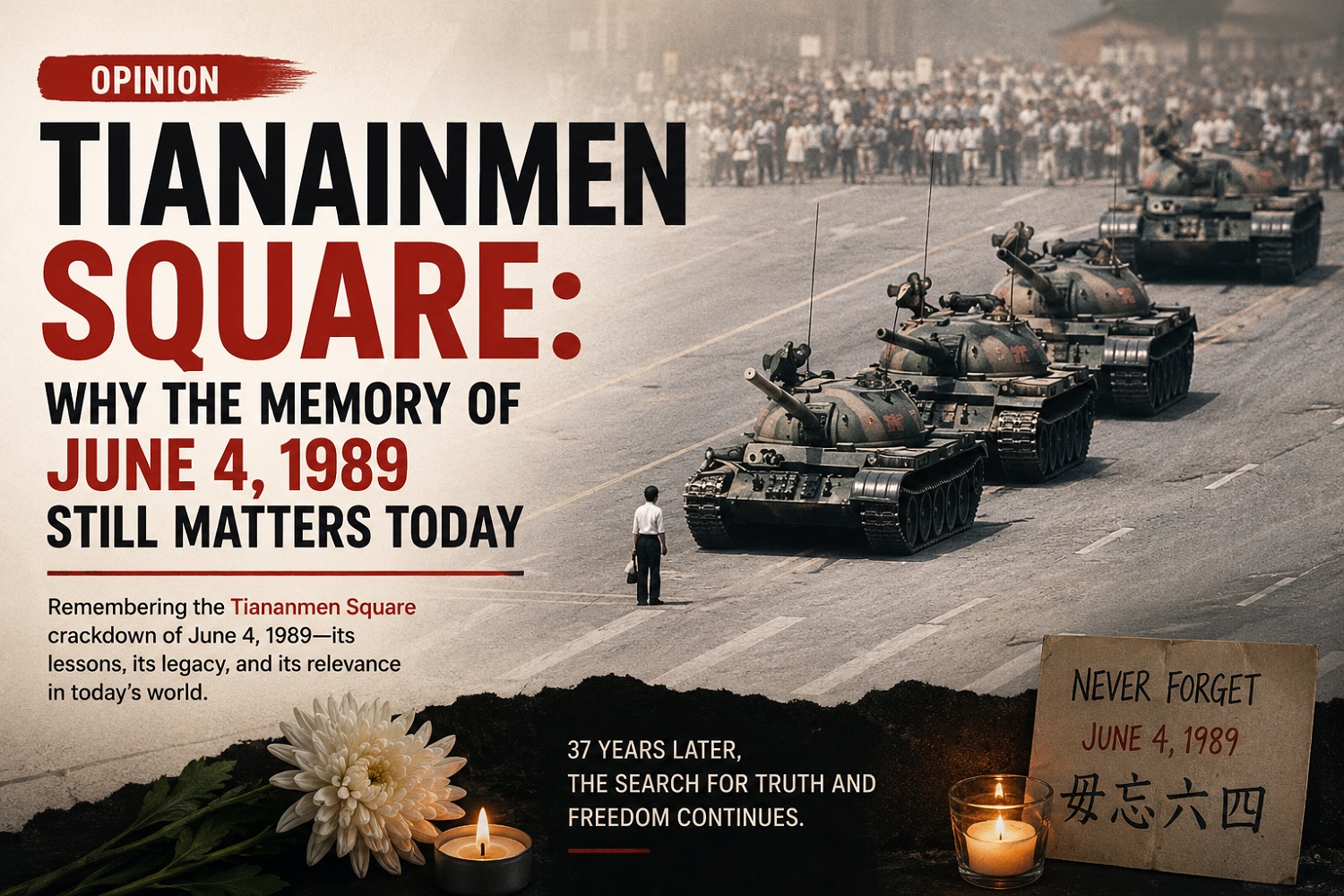
Perhaps no image captures this reality more powerfully than that of the unidentified “Tank Man.” Standing alone before a column of military tanks, he became an international symbol of individual courage. Whether viewed as an act of defiance, conscience, or simple human determination, the image remains one of the most recognizable photographs of the twentieth century. Its power lies in its simplicity: one person confronting overwhelming force.
At the same time, any discussion of Tiananmen Square should acknowledge the complexity of China’s subsequent development. Since 1989, China has experienced extraordinary economic growth, technological advancement, and rising global influence. Hundreds of millions of people have seen improvements in living standards. These achievements are undeniably important and form a significant part of the country’s modern story.
Yet economic success does not automatically erase historical wounds. Prosperity and memory can coexist. Nations are often strongest when they possess the confidence to examine difficult chapters of their history honestly rather than avoiding them. Open discussion of the past is not necessarily a sign of weakness; it can be a sign of maturity and self-confidence.
The enduring relevance of Tiananmen Square extends beyond China itself. Around the world, citizens continue to debate issues such as freedom of expression, government accountability, public protest, and civil rights. The events of June 4, 1989, serve as a reminder that these questions remain central to modern political life.
Thirty-seven years later, Tiananmen Square is no longer merely a historical event. It has become a symbol—one interpreted differently by different people but impossible to ignore. Whether viewed through the lens of political reform, human rights, state authority, or historical memory, its significance remains undiminished.
As another anniversary passes, the most important lesson may be that remembering history matters. Societies move forward not by forgetting difficult moments but by understanding them. The story of Tiananmen Square continues to challenge the world to reflect on the value of truth, the power of memory, and the enduring human desire to be heard.
Image: The image is AI generated only to display the content of the article.